20 Bible Verses About Forgiveness You Have Not Managed Yet
Forgiveness can be one of the hardest words to hear when the wound is still affecting your life. These forgiveness Bible verses do not ask you to call harm harmless, restore trust before it is earned, or rush past grief. They help you bring the unfinished work to God and take one faithful step at a time.
What Does the Bible Say About Forgiveness When You Are Still Hurt?
The Bible calls believers to forgive, but it does not define forgiveness as pretending the harm did not happen or returning unsafe access. Biblical forgiveness releases personal vengeance to God, tells the truth about sin, and refuses to let retaliation become the guide for your next decision.
After my 26-year marriage ended, forgiveness was not one clean spiritual moment. The consequences remained in legal decisions, finances, family changes, work, and grief. I could surrender one layer to God and later discover another layer underneath it.
I learned that forgiveness could begin before the pain was finished. It did not require me to deny what had happened, and it did not make trust, access, or reconciliation automatic. It gave me a way to stop carrying the job of vengeance while still stewarding truth, wisdom, and the responsibilities God had placed in my care.
Which Forgiveness Bible Verses Help You Receive Mercy First?
These first six forgiveness Bible verses begin with God’s mercy because it is difficult to extend what you believe you have never received. Read them slowly and let grace become the starting place rather than a demand to perform forgiveness perfectly.
1. Psalm 103:10–12
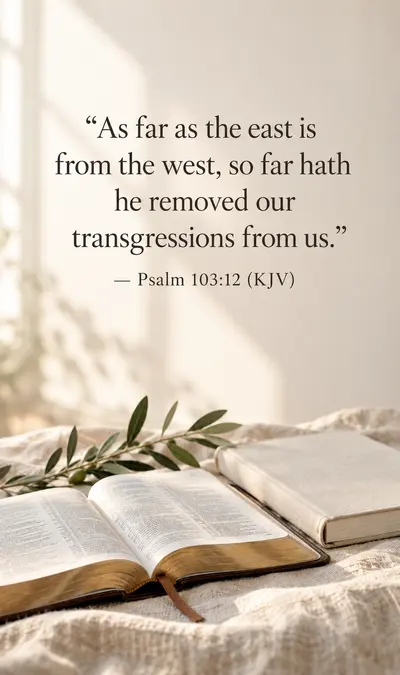
“He hath not dealt with us after our sins; nor rewarded us according to our iniquities. For as the heaven is high above the earth, so great is his mercy toward them that fear him. As far as the east is from the west, so far hath he removed our transgressions from us.”
God’s mercy does not minimize sin; it shows how completely He is able to remove its charge. Begin here when shame tells you that grace is available to everyone except you.
2. Isaiah 1:18
“Come now, and let us reason together, saith the LORD: though your sins be as scarlet, they shall be as white as snow; though they be red like crimson, they shall be as wool.”
God invites His people to come near and face the truth with Him. Forgiveness is not achieved by covering the stain yourself; cleansing is the work He offers.
3. Isaiah 43:25
“I, even I, am he that blotteth out thy transgressions for mine own sake, and will not remember thy sins.”
The Lord grounds forgiveness in His own character. His promise not to remember is not a loss of knowledge; it is His decision not to keep holding forgiven guilt against His people.
4. Micah 7:18–19
“Who is a God like unto thee, that pardoneth iniquity, and passeth by the transgression of the remnant of his heritage? he retaineth not his anger for ever, because he delighteth in mercy. He will turn again, he will have compassion upon us; he will subdue our iniquities; and thou wilt cast all their sins into the depths of the sea.”
God does not offer mercy reluctantly. Micah says He delights in it. Let that truth correct the picture of a God who is eager to shame you for returning with an honest confession.
5. Daniel 9:9
“To the Lord our God belong mercies and forgivenesses, though we have rebelled against him;”
Mercy and forgiveness belong to God even in the presence of real rebellion. You do not need to soften the truth about sin before you can acknowledge the greater truth about His character.
6. 1 John 1:9
“If we confess our sins, he is faithful and just to forgive us our sins, and to cleanse us from all unrighteousness.”
Forgiveness begins with honesty before God, not image management. His faithfulness is the foundation of the promise, which means mercy is not something you have to manufacture or earn.
Which Forgiveness Bible Verses Help You Release Revenge?
These eight verses help you release revenge by moving the right to repay out of your hands and into God’s. They do not require you to approve of the harm; they call you to refuse retaliation and bring the person, the wound, and the outcome before the Lord.
7. Matthew 6:14–15
“For if ye forgive men their trespasses, your heavenly Father will also forgive you: But if ye forgive not men their trespasses, neither will your Father forgive your trespasses.”
Jesus speaks seriously about forgiveness because received mercy is meant to reshape the way we treat others. Use this passage as an invitation to surrender, not as a weapon for shaming someone whose wound is still tender.
8. Matthew 18:21–22
“Then came Peter to him, and said, Lord, how oft shall my brother sin against me, and I forgive him? till seven times? Jesus saith unto him, I say not unto thee, Until seven times: but, Until seventy times seven.”
Forgiveness is not a scorecard that lets resentment return after the final tally. Repeated forgiveness may be necessary, but the command does not require you to offer repeated access to someone who keeps choosing harm.
9. Mark 11:25
“And when ye stand praying, forgive, if ye have ought against any: that your Father also which is in heaven may forgive you your trespasses.”
Prayer gives you a place to name what you are holding and release it before God. You may need to make that choice again when the memory returns; repetition does not mean the earlier surrender was false.
10. Luke 6:27–28
“But I say unto you which hear, Love your enemies, do good to them which hate you, Bless them that curse you, and pray for them which despitefully use you.”
Praying for someone is not the same as approving what they did. It places the person before God and asks Him to work with truth and mercy while keeping hatred from becoming your master.
11. Luke 6:37
“Judge not, and ye shall not be judged: condemn not, and ye shall not be condemned: forgive, and ye shall be forgiven:”
Jesus calls us away from a condemning posture. That does not erase discernment or consequences; it means you do not need to appoint yourself as the final judge of another person’s soul.
12. Luke 17:3–4
“Take heed to yourselves: If thy brother trespass against thee, rebuke him; and if he repent, forgive him. And if he trespass against thee seven times in a day, and seven times in a day turn again to thee, saying, I repent; thou shalt forgive him.”
Truth, repentance, and forgiveness appear together in this teaching. Biblical mercy does not require silence; Jesus makes room to name the trespass and respond to genuine repentance.
13. Luke 23:34
“Then said Jesus, Father, forgive them; for they know not what they do. And they parted his raiment, and cast lots.”
Jesus prayed in the middle of injustice, entrusting the offenders to His Father. His prayer did not call the crucifixion good; it revealed mercy without rewriting the truth about what was happening.
14. Acts 7:60
“And he kneeled down, and cried with a loud voice, Lord, lay not this sin to their charge. And when he had said this, he fell asleep.”
Stephen’s prayer is an extraordinary picture of Christ-shaped mercy. Let it point you toward God without turning another person’s holy moment into a timetable you must force on your own grief.

Which Verses Show Forgiveness With Wisdom and Boundaries?
These final six verses show that forgiveness can be practiced with wisdom, truth, and appropriate limits. Scripture forbids revenge and calls you toward compassion, while also recognizing repentance, possible peace, and the careful repair of relationships.
15. Romans 12:17–18
“Recompense to no man evil for evil. Provide things honest in the sight of all men. If it be possible, as much as lieth in you, live peaceably with all men.”
You are responsible for the part that lies with you, not for controlling another person’s response. The words if it be possible make room for the reality that peace cannot always be completed by one willing person.
16. Romans 12:19–21
“Dearly beloved, avenge not yourselves, but rather give place unto wrath: for it is written, Vengeance is mine; I will repay, saith the Lord. Therefore if thine enemy hunger, feed him; if he thirst, give him drink: for in so doing thou shalt heap coals of fire on his head. Be not overcome of evil, but overcome evil with good.”
Releasing vengeance does not declare that justice is unnecessary; it declares that you are not its ultimate owner. Choosing good keeps another person’s wrongdoing from deciding who you will become.
17. Ephesians 4:31–32
“Let all bitterness, and wrath, and anger, and clamour, and evil speaking, be put away from you, with all malice: And be ye kind one to another, tenderhearted, forgiving one another, even as God for Christ's sake hath forgiven you.”
Putting away bitterness is not the same as denying pain. Paul roots tenderness and forgiveness in what God has done through Christ, giving you a source deeper than your own emotional supply.
18. Colossians 3:12–13
“Put on therefore, as the elect of God, holy and beloved, bowels of mercies, kindness, humbleness of mind, meekness, longsuffering; Forbearing one another, and forgiving one another, if any man have a quarrel against any: even as Christ forgave you, so also do ye.”
Compassion, humility, patience, and forgiveness belong together. These are not signs that harm was acceptable; they are ways of remaining rooted in Christ while deciding what faithful response belongs to you.
19. 2 Corinthians 2:7–8
“So that contrariwise ye ought rather to forgive him, and comfort him, lest perhaps such a one should be swallowed up with overmuch sorrow. Wherefore I beseech you that ye would confirm your love toward him.”
In this church situation, correction had done its work and restoration was now needed. The passage reminds us that forgiveness can include comfort and renewed love when repentance and repair are truly present.
20. 1 Peter 3:8–9
“Finally, be ye all of one mind, having compassion one of another, love as brethren, be pitiful, be courteous: Not rendering evil for evil, or railing for railing: but contrariwise blessing; knowing that ye are thereunto called, that ye should inherit a blessing.”
You are not called to mirror the harm done to you. Blessing instead of retaliating can coexist with telling the truth, seeking appropriate help, and refusing continued access to destructive behavior.

Does Forgiveness Mean You Must Reconcile or Trust Again?
No. Biblical forgiveness does not automatically require reconciliation, restored trust, or renewed access. Those parts of relationship involve different responsibilities and may require truth, repentance, safety, and a credible pattern of change.
Forgiveness is your surrender of personal vengeance to God. It can begin even when the other person will not participate.
Reconciliation is relational repair. It normally requires more than one person, honest acknowledgment, and willingness to change.
Trust is rebuilt through consistent, trustworthy behavior over time. Forgiving someone does not make evidence unnecessary.
Access is a stewardship decision. You may forgive and still limit contact, change the form of a relationship, or keep a needed boundary.
If you need help separating mercy from unlimited access, what the bible says about boundaries can help you think through the next faithful step without treating wisdom as a lack of love.
What Can You Do When You Want to Forgive but Cannot Force the Feeling?
When you want to forgive but cannot force the feeling, choose one honest act of surrender instead of demanding an instant emotional finish line. Feelings may take longer to follow, especially when the effects of the wound are still present.
1. Tell God the truth about what happened.
Name the harm without exaggerating it and without making it smaller. God already knows; honest prayer lets you stop carrying the appearance that you are fine.
2. Name what you are releasing today.
You may not be able to settle every part of the story at once. Release the demand to personally repay, control the outcome, or rehearse the case for one more hour.
3. Separate forgiveness from consequences.
A forgiven wrong may still require a boundary, restitution, church accountability, professional support, or a lawful process. Mercy and responsible stewardship are not enemies.
4. Choose the next faithful boundary or action.
Ask what protects truth, peace, and the responsibilities God has given you. The next step may be a conversation, a pause, written communication, wise counsel, or no new contact for now.
5. Return the next layer when it rises.
Forgiveness can be a decision you revisit as grief reveals new layers. Returning to God is not failure; it is how ongoing surrender becomes a practiced way of living.
For a wider collection to support the rest of your rebuilding, keep these bible verses for every season of rebuilding nearby and choose the section that meets the need in front of you.
What Are Common Questions About Biblical Forgiveness?
What if the person never apologizes?
You can still bring your desire for revenge to God and refuse to let bitterness direct your life. Their lack of repentance may affect reconciliation, trust, and access, but it does not prevent you from asking God to free your heart from the work of personal retaliation.
Do I have to tell the person I forgive them?
Not every situation requires direct contact, and contact may be unwise or unsafe. Seek wise counsel about whether a conversation would serve truth and peace; forgiveness before God is not dependent on reopening a harmful door.
Does forgiveness mean I must stop feeling angry?
No. Anger can alert you that something mattered and something was violated. Bring it under God’s care, refuse sinful retaliation, and allow grief, prayer, wise support, and time to help your emotions catch up with the choice you are making.
Can I forgive and still seek legal, pastoral, or professional help?
Yes. Forgiveness does not prohibit appropriate reporting, protection, accountability, counseling, pastoral care, or lawful action. Seeking qualified help can be part of truthful and responsible stewardship.
Could Steady, Inch by Inch Help You Keep Moving?
Steady, Inch by Inch can support you when forgiveness and rebuilding are happening in layers rather than all at once. It offers a gentle structure for choosing the next faithful step without demanding that you solve the whole future today.
When you are ready, you can continue with Steady, Inch by Inch. This simple resource is designed to help you begin without feeling as though you have to rebuild everything at once. The invitation is optional; a purchase is never a measure of your faith or healing.
You do not have to declare the work finished today. Choose one verse that helps you tell the truth about God, the wound, and the next faithful step. Let forgiveness begin as surrender, then allow wisdom, time, and fruit to show you what restoration should—and should not—look like.
God gives the growth. We give the stewardship.
I am not standing at the finish line looking back. I am on the trail with you.
One faithful step at a time,
Elizabeth Jane