
What Does the Bible Say About Boundaries
The bible never uses the word boundaries, but it shows them constantly: God sets one in Genesis 2:16-17, Nehemiah refuses four invitations in Nehemiah 6:3, Christ withdraws from crowds in Mark 6:31, and Paul tells us to bear our own burden in Galatians 6:5. Christian boundaries are limits kept for the sake of the work God gave you, not walls built to keep people out.
If you have ever been told that setting a limit is unloving, this is the post for you.
Christian boundaries start in the first two chapters
Before the fall, before there is anything to protect anyone from, there is a limit.
Genesis 2:16-17 — And the LORD God commanded the man, saying, Of every tree of the garden thou mayest freely eat: But of the tree of the knowledge of good and evil, thou shalt not eat of it: for in the day that thou eatest thereof thou shalt surely die.
Read the proportion of it. Every tree, freely. One exception.
That is the shape of a healthy limit, and it is worth sitting with, because most of us have it backwards. We think a boundary is the fence. In Genesis the boundary is one tree in an entire garden, and everything else is yes.
What would it change if your limits were that generous?
What the bible says about boundaries: six examples
1. God gives one and explains it. Genesis 2:16-17, above. Not a rule for its own sake. A limit with a reason attached.
2. Nehemiah refuses to come down. He is rebuilding the wall, and four separate times he is invited to meet with people who mean him harm.
Nehemiah 6:3 — And I sent messengers unto them, saying, I am doing a great work, so that I cannot come down: why should the work cease, whilst I leave it, and come down to you?
He does not argue. He does not explain himself, or apologize, or offer a different date. He says what he is doing and that he is not stopping. That is the cleanest boundary in scripture, and it is one sentence long.
What are you building that you keep coming down from?
3. Christ withdraws from people who need him.
Mark 6:31 — And he said unto them, Come ye yourselves apart into a desert place, and rest a while: for there were many coming and going, and they had no leisure so much as to eat.
The crowds did not stop needing him. He went anyway, and he took the others with him.
Luke 5:16 — And he withdrew himself into the wilderness, and prayed.
Not once. The verb is habitual — this was a practice, not an exception.
4. Paul names a person and warns about him.
2 Timothy 4:14-15 — Alexander the coppersmith did me much evil: the Lord reward him according to his works: Of whom be thou ware also; for he hath greatly withstood our words.
Be aware of him too. Paul does not pretend the harm did not happen, and he does not tell Timothy to trust the man anyway.
5. Proverbs is practical about who you spend time with.
Proverbs 22:24 — Make no friendship with an angry man; and with a furious man thou shalt not go:
Not fix him. Not be patient with him. Do not go with him.
6. Christ gives a procedure for someone who will not listen.
Matthew 18:15-17 — Moreover if thy brother shall trespass against thee, go and tell him his fault between thee and him alone: if he shall hear thee, thou hast gained thy brother. But if he will not hear thee, then take with thee one or two more, that in the mouth of two or three witnesses every word may be established. And if he shall neglect to hear them, tell it unto the church: but if he neglect to hear the church, let him be unto thee as an heathen man and a publican.
Three attempts, in order, and then a change in the relationship. This is the passage people skip, and it is the one that gives you permission to stop.
How many attempts have you made already?
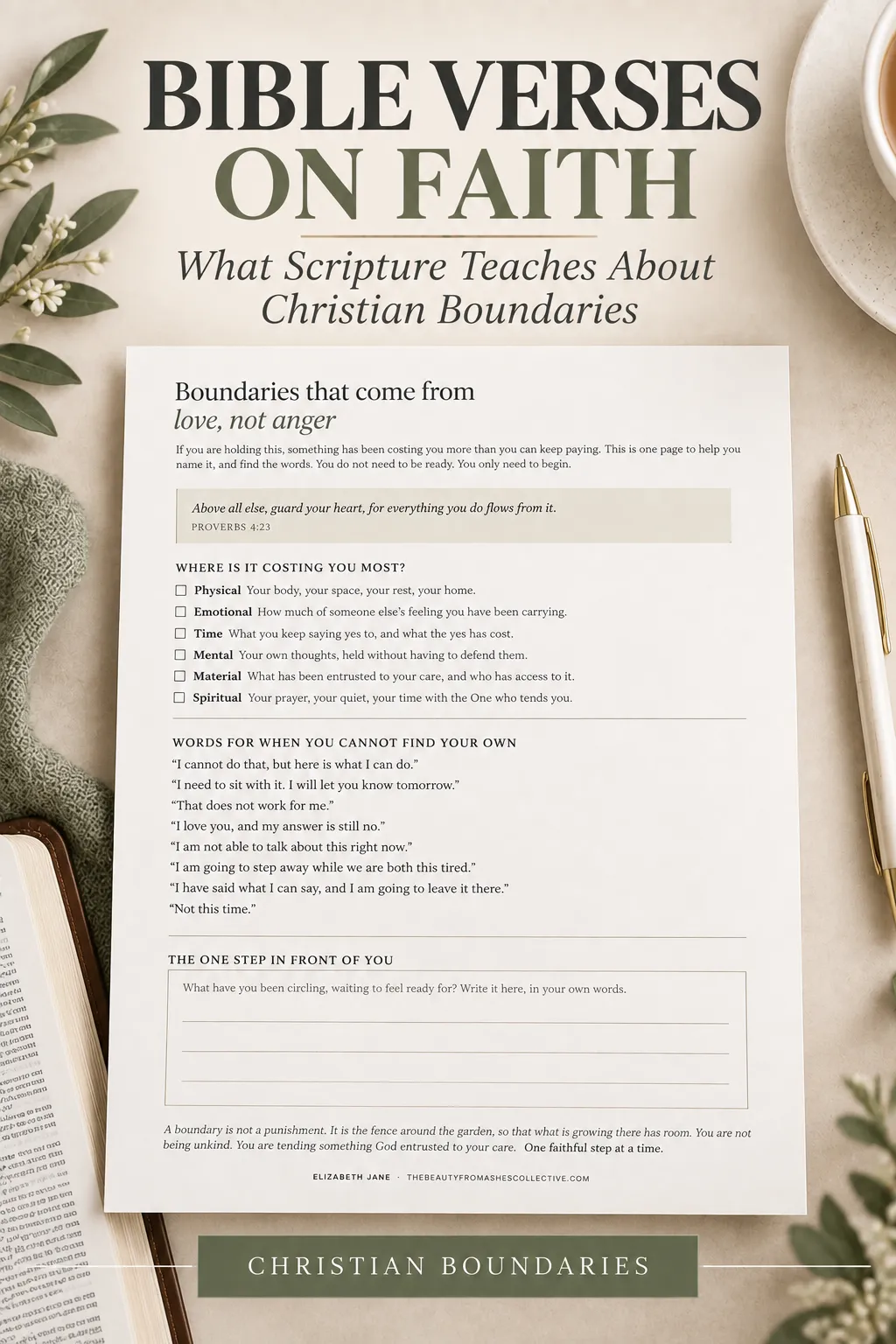
Christian boundaries and the verses used against them
Two verses get quoted at women who are trying to set a limit. Both are usually quoted badly.
“Bear ye one another’s burdens.”
Galatians 6:2 — Bear ye one another’s burdens, and so fulfil the law of Christ.
Three verses later, in the same paragraph, Paul writes this.
Galatians 6:5 — For every man shall bear his own burden.
They are not a contradiction. The word is different in the Greek. Verse 2 uses baros, a crushing weight — the kind nobody is expected to carry alone. Verse 5 uses phortion, the word for a soldier’s own pack, the ordinary daily load each of us is meant to carry.
Help her lift the boulder. Do not carry her backpack for the rest of her life.
“Live peaceably with all men.”
Romans 12:18 — If it be possible, as much as lieth in you, live peaceably with all men.
Two conditions, both in the verse. If it be possible. As much as lieth in you. Nobody is asking you to produce peace on your own, and Paul allows for the possibility that it will not be available.
Which of those two has been used on you?
How to set christian boundaries without guilt
1. Decide what the work is. Nehemiah could refuse because he knew what he was building. If you cannot name what your limit is protecting, the guilt has nothing to push against.
2. Say it once and stop explaining. “I am doing a great work, so that I cannot come down.” That is the whole answer. Every reason you add is a door.
3. Do not diagnose anyone. Paul says Alexander did him harm and to be aware. He does not label the man. Name the behavior, name what you will do, leave the rest.
4. Expect the guilt and go anyway. Christ withdrew from people who genuinely needed him. If he could do that without sinning, so can you.
5. Keep the yes generous. Every tree in the garden. If your limits have grown until almost everything is a no, the problem is probably not the boundary — it is that you are exhausted, and that is worth attending to first.
Where has your yes gone?
For the wider version of all this, read boundaries that come from love, and if the word itself is where you get stuck, start with what are boundaries.
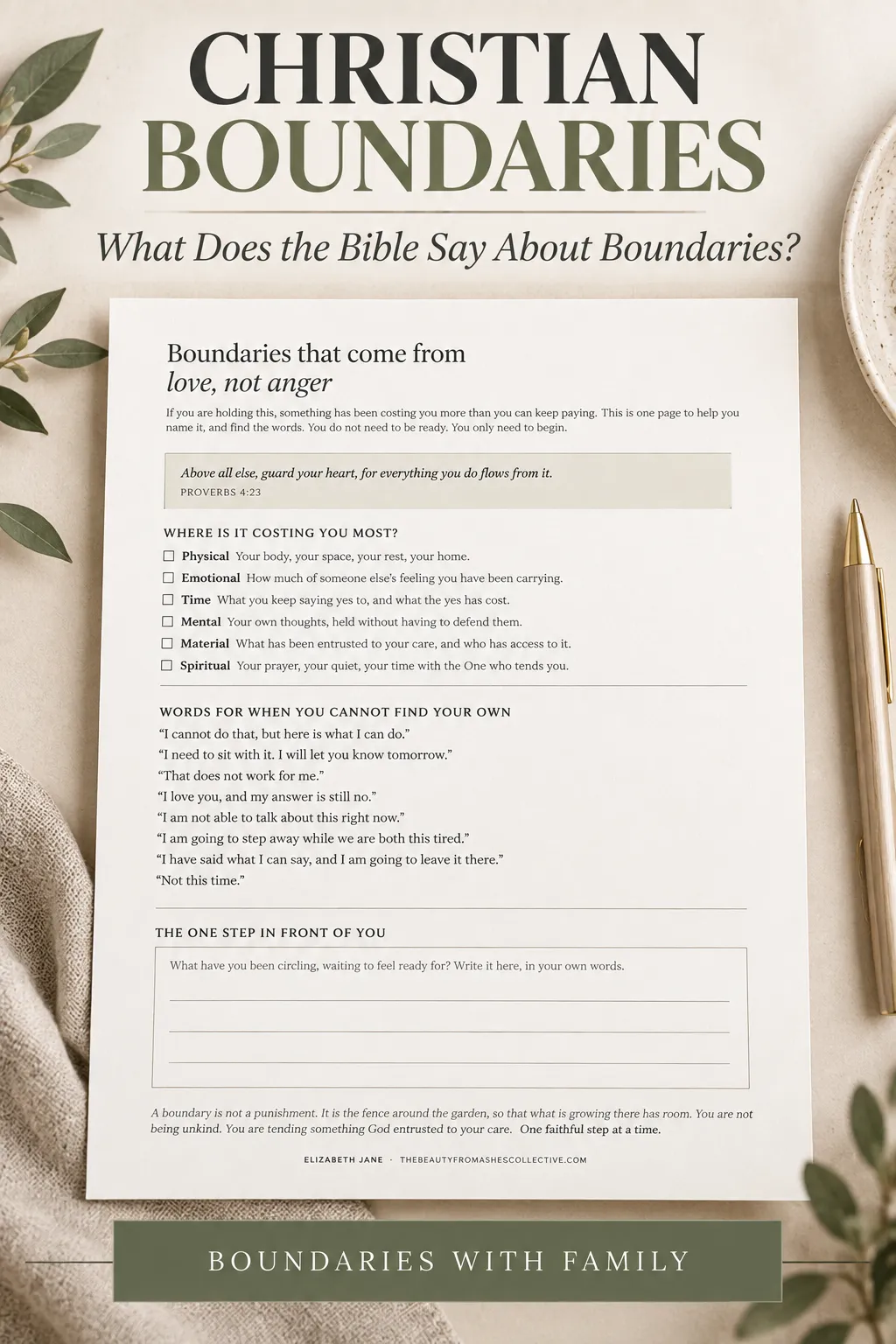
Not sure where to start? Name it on paper first.
This free printable walks you through exactly where the cost has been adding up, gives you the words for when you can't find your own, and one page to write down the single next step in front of you.
Where to start when the guilt is the loudest part
Most women who ask what the bible says about boundaries are not really asking about scripture. They are asking whether they are allowed.
You are. And the harder question is usually which limit to set first, when four things need attention and you have the energy for one.
That is what I wrote Your First Step Guide for. It takes one area of your life and gives you the single next thing to do in it — not a plan, not a system, one step. It is $17 and about twenty pages, meant to be read in one sitting.
A boundary is not a punishment. It is the fence around the garden, so that what is growing there has room. You are not being unkind. You are tending something God entrusted to your care.
You do not have to become a completely different person to faithfully steward the life God has entrusted to you. You simply need to begin, right here, right now, with what is already in your hands.
One faithful step at a time,
Elizabeth Jane