
25 Bible Verses for Women Carrying More Than They Say
Have you ever carried an entire world behind a calm answer, a capable smile, or the words "I am fine"? You may be tending responsibilities, grief, decisions, relationships, and practical needs while very few people understand what the weight is costing you.
These women Bible verses offer steady truth for the days when you are carrying more than you say. They do not ask you to deny what is hard or prove that you can handle everything. They remind you that God sees you, invites you to receive help, gives wisdom for boundaries, and meets you in one faithful step at a time.
What does God say to women carrying more than they reveal?
God sees the full weight a woman carries, including the parts she has not been able to explain to anyone else.
For years, I became very good at carrying what needed to be carried. I could manage a home, work, schedules, emotions, and the needs of the people around me while saying very little about what it cost. After my life changed suddenly, I began learning that endurance and stewardship are not always the same thing. Faithfulness does not require a woman to disappear inside everyone else's needs.
Some burdens are ours to tend. Some are meant to be shared. Some require a boundary, a season of rest, or the courage to tell the truth. Others belong in God's hands because they were never ours to control. Scripture helps us separate faithful responsibility from silent self-erasure.
Why do women sometimes carry so much without saying it?
Women often carry silently because responsibility, love, survival, and the fear of disappointing others can become tangled together.
Sometimes silence began as protection. You may have learned that expressing a need brought criticism, dismissal, conflict, or another problem to manage. You may be the person everyone depends on, so admitting that you are tired feels risky. None of this means you are weak. It means your mind and body may have learned to keep moving before they learned that support could be safe.
Godly stewardship includes truth. It allows you to notice the condition of your body, your emotions, your relationships, your spiritual life, and the practical responsibilities in front of you. A wise boundary, an honest request, or a needed pause can be an act of faith rather than a failure of it.
Which Bible verses remind you that God sees what others miss?
These verses show that God notices hidden sorrow, private tears, complicated stories, and the heart beneath a woman's outward strength.
1. Genesis 16:13 - God sees the woman others overlook
"And she called the name of the LORD that spake unto her, Thou God seest me."
Hagar spoke these words in the wilderness after being mistreated and fleeing from home. Being seen by God did not make the wrong done to her acceptable. It meant that her location, fear, and future were not invisible. When no one seems to understand the whole story, you can begin here: God sees you clearly.
2. 1 Samuel 1:15 - Your sorrow can be poured out honestly
"I am a woman of a sorrowful spirit: I have drunk neither wine nor strong drink, but have poured out my soul before the LORD."
Hannah was so distressed that Eli misunderstood what he saw. She answered without pretending and named the sorrow in her spirit. Her prayer reminds us that deep feeling is not spiritual failure. You do not have to make your pain sound polished before bringing it to God.
3. Psalm 56:8 - Your tears are not lost
"Thou tellest my wanderings: put thou my tears into thy bottle: are they not in thy book?"
David used intimate language for God's attention to grief. The image of collected tears does not promise that sorrow disappears quickly. It tells us that what you have cried in private still matters. God is not impatient with the evidence that this season has hurt.
4. Psalm 139:1-3 - God knows the details of your days
"O LORD, thou hast searched me, and known me. Thou knowest my downsitting and mine uprising, thou understandest my thought afar off. Thou compassest my path and my lying down, and art acquainted with all my ways."
This psalm describes a God who knows ordinary movement, private thought, work, and rest. You do not have to summarize your life perfectly for Him. He understands the accumulation of small demands and the thoughts that arrive before you have words for them.
5. Psalm 34:18 - God comes near to a broken heart
"The LORD is nigh unto them that are of a broken heart; and saveth such as be of a contrite spirit."
God's nearness is not reserved for the woman who has already recovered. This verse speaks directly to the brokenhearted. If you are functioning while still hurting, you do not have to hide the broken place from God in order to be worthy of His presence.

Which Bible verses help when the burden is too heavy?
These verses invite the burdened to come to Christ, release care, receive shared support, and admit when a load cannot be carried alone.
6. Matthew 11:28 - Jesus invites the heavy laden to rest
"Come unto me, all ye that labour and are heavy laden, and I will give you rest."
Jesus does not begin by asking the weary to perform better. He begins with an invitation to come. Rest in Christ may include prayer, but it may also include sleep, nourishment, medical care, wise counsel, practical help, or stepping away from demands that are not yours to keep meeting.
7. Psalm 55:22 - You were not created to hold every burden by yourself
"Cast thy burden upon the LORD, and he shall sustain thee: he shall never suffer the righteous to be moved."
Psalm 55 grows out of distress and betrayal by someone close. Casting a burden on God is not pretending that the relationship or circumstance did not wound you. It is returning the weight to Him repeatedly while you seek the kind of support, protection, and wisdom the situation requires.
8. 1 Peter 5:7 - Your cares matter because you matter to God
"Casting all your care upon him; for he careth for you."
The reason given here is personal: God cares for you. Not only for the outcome, the family, the ministry, the work, or the people depending on you. He cares for the woman underneath those responsibilities. You are allowed to bring Him the care beneath the task.
9. Galatians 6:2 - Burden bearing belongs in community
"Bear ye one another's burdens, and so fulfil the law of Christ."
This instruction assumes that burdens become visible enough to be shared. Support can be spiritual, emotional, or practical: a listening ear, a meal, a ride, professional guidance, help with a task, or someone standing beside you while you make a difficult decision. Receiving care gives another person the opportunity to live the law of Christ.
10. Exodus 18:17-18 - Doing everything alone can wear you away
"The thing that thou doest is not good. Thou wilt surely wear away, both thou, and this people that is with thee: for this thing is too heavy for thee; thou art not able to perform it thyself alone."
Jethro told Moses plainly that his current way of carrying leadership was unsustainable. Delegation was not a character failure; it was wisdom. Sometimes the faithful question is not, "How can I become strong enough to keep doing all of this?" but, "What needs to change so this does not keep wearing me away?"
If the weight has brought you to the point when you feel like giving up, this companion collection offers Scripture for the next moment without demanding false positivity.
Which Bible verses give you permission to rest and receive care?
These verses show that rest, restoration, and renewed strength belong inside faithful living rather than outside it.
11. Mark 6:31 - Jesus noticed when His disciples needed a pause
"Come ye yourselves apart into a desert place, and rest a while: for there were many coming and going, and they had no leisure so much as to eat."
The need was practical and bodily: people kept coming, and the disciples had not even had time to eat. Jesus did not spiritualize their depletion. He acknowledged it. If your basic needs keep disappearing beneath everyone else's urgency, this verse offers permission to notice and respond.
12. Luke 10:41-42 - Being troubled by many things is not the same as being faithful to all of them
"Martha, Martha, thou art careful and troubled about many things: But one thing is needful."
Jesus addressed Martha tenderly by name. The passage is not a condemnation of service; hospitality mattered. It is a reordering of attention. When many good or necessary things compete at once, wisdom asks what is truly needful now instead of treating every demand as equally urgent.
13. Psalm 23:2-3 - God leads toward restoration
"He maketh me to lie down in green pastures: he leadeth me beside the still waters. He restoreth my soul."
The Shepherd does not drive the sheep without pause. He leads them toward nourishment, water, and restoration. Your soul is not a machine. Restoring it may be quiet and gradual, but that work belongs to God's care for you.
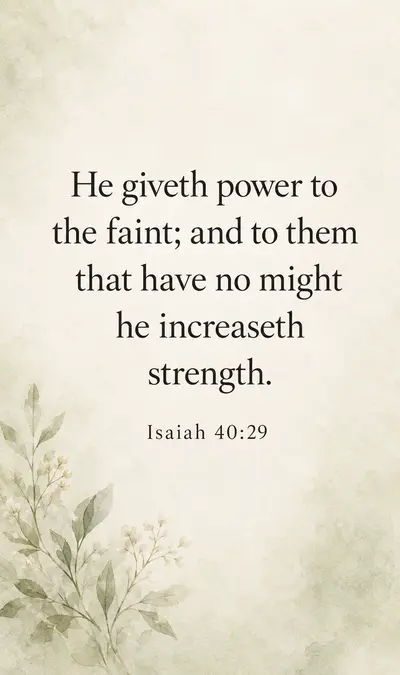
14. Isaiah 40:29 - God gives power to the faint
"He giveth power to the faint; and to them that have no might he increaseth strength."
This verse does not shame the faint for becoming tired. It names the depleted condition and names God as the giver. When you have no might, receiving can be the next faithful act: receive truth, help, rest, nourishment, protection, or the grace to do only what belongs to today.
15. Psalm 73:26 - A failing heart does not mean a failed faith
"My flesh and my heart faileth: but God is the strength of my heart, and my portion for ever."
The psalmist does not hide human limitation. Body and heart can both reach an edge. You may be emotionally and physically tired while still belonging fully to God. His strength is not proof that you should ignore your limits; it is a place to stand while you honor them.
Which Bible verses help you take a wise and faithful next step?
These verses connect courage with guarded wisdom, God's presence, and one steady decision rather than pressure to solve everything at once.
16. Proverbs 4:23 - Guarding your heart is part of wisdom
"Keep thy heart with all diligence; for out of it are the issues of life."
Guarding the heart is not becoming cold or withholding love. It is paying attention to what shapes your inner life. A wise boundary can protect truth, peace, health, and the relationships that are genuinely yours to steward. Love does not require unlimited access to you.
17. James 1:5 - You can ask God for wisdom without being shamed
"If any of you lack wisdom, let him ask of God, that giveth to all men liberally, and upbraideth not; and it shall be given him."
This promise is especially tender because God gives without reproach. You do not have to know the perfect answer before you pray. Ask for wisdom about the conversation, boundary, appointment, expense, relationship, or decision directly in front of you.
18. Isaiah 41:10 - God will help and uphold you
"Fear thou not; for I am with thee: be not dismayed; for I am thy God: I will strengthen thee; yea, I will help thee."
God's answer to fear begins with His presence. The verse does not say the circumstance is imaginary or that courage must arrive before you move. It reminds you that help and strength do not depend entirely on what you can generate from within yourself.
19. Deuteronomy 31:8 - God goes before you into what you cannot yet see
"And the LORD, he it is that doth go before thee; he will be with thee, he will not fail thee, neither forsake thee."
Moses spoke these words to Joshua before a demanding transition. You may not know how the whole next chapter will unfold. You can still take the next honest step without assuming that uncertainty means abandonment.
20. Psalm 46:1 - Help is present in trouble
"God is our refuge and strength, a very present help in trouble."
The psalm describes an unstable world, yet calls God present. Refuge is not denial. It is where you turn while trouble is real. Seeking a safe place, trustworthy people, or practical protection can work alongside prayer rather than against it.
Which Bible verses meet you when words fail?
These verses make room for wordless prayer, poured-out emotion, anxious thoughts, weakness, and difficult passages that still must be crossed.
21. Psalm 62:8 - You may pour out your heart before God
"Trust in him at all times; ye people, pour out your heart before him: God is a refuge for us."
Biblical trust is not emotional silence. The psalm joins trust with pouring out the heart. Tell God what is true before trying to make it sound faithful. Anger, grief, confusion, and weariness can be brought into relationship with Him.
22. Romans 8:26 - The Spirit helps when you do not know how to pray
"Likewise the Spirit also helpeth our infirmities: for we know not what we should pray for as we ought: but the Spirit itself maketh intercession for us with groanings which cannot be uttered."
Not knowing what to say is named here as part of human weakness, not a disqualification from prayer. When language disappears, you can sit before God, breathe, cry, or offer one honest sentence. The Spirit is not limited by your ability to explain.
23. Philippians 4:6-7 - Prayer can hold the requests your mind keeps repeating
"In every thing by prayer and supplication with thanksgiving let your requests be made known unto God. And the peace of God, which passeth all understanding, shall keep your hearts and minds through Christ Jesus."
This passage offers a practice, not a reason to shame anxiety. Bring the specific request to God as often as needed. Peace may arrive as enough steadiness for the next hour, enough clarity for one decision, or enough support to ask someone trustworthy for help.
24. 2 Corinthians 12:9 - Grace meets the place that has not been fixed
"My grace is sufficient for thee: for my strength is made perfect in weakness."
Paul had asked for his thorn to be removed, and the answer did not promise immediate relief. God's grace within an unresolved reality is not proof that the pain is unimportant. It is sustaining presence while you continue to seek wise care and take faithful steps.
25. Isaiah 43:2 - God is with you through what must be crossed
"When thou passest through the waters, I will be with thee; and through the rivers, they shall not overflow thee."
Notice the word through. Scripture does not teach that faithful women avoid every deep water. It offers the steadier assurance of God's presence in the crossing. You do not have to call the water shallow in order to believe that He is with you.

This collection belongs inside a broader guide to bible verses for every season of rebuilding, including strength, healing, peace, forgiveness, new beginnings, and the days when you can only hold on to one line at a time.
How can you carry your responsibilities without carrying them alone?
You can carry your responsibilities more faithfully by separating what is yours to steward from what needs to be shared, changed, or released.
Name the real load. Write down what you are carrying without minimizing it. Include emotional labor, decisions, caregiving, work, finances, health, grief, and the needs that have remained unspoken.
Separate responsibility from rescue. Ask which responsibilities are truly yours and which ones belong to another capable adult, an organization, a professional, or God. Caring is not the same as controlling every outcome.
Let one safe person know. Choose someone trustworthy and specific. Instead of saying only, "I am overwhelmed," try, "Could you listen for ten minutes?" or, "Could you help me with this one task?"
Choose one boundary that protects what matters. A boundary might involve time, access, communication, spending, rest, or the amount of work you agree to carry. Keep it clear, kind, and connected to stewardship rather than punishment.
Take one faithful step. Do the next manageable thing, not the entire future. Send one message, make one appointment, drink water, eat, rest, pray one sentence, or complete one ten-minute task.
What Bible verse helps a woman who feels unseen?
Genesis 16:13 is a strong place to begin because Hagar names God as the One who sees her in the wilderness.
Her story is not a sentimental picture of an easy life. She had been mistreated and was in distress. The verse offers something grounded: your pain can be real, the wrong can still be wrong, and you can still be fully seen by God.
Does trusting God mean you should keep carrying everything?
No, trusting God does not mean accepting every demand, doing everyone's work, or ignoring your physical and emotional limits.
Exodus 18 shows that an unsustainable workload needed to change. Galatians 6 assumes burdens can be shared. Mark 6 records Jesus inviting exhausted disciples to rest. Trust may lead you to delegate, ask for help, seek qualified support, or establish a wise boundary.
Is asking for help a sign of weak faith?
No, asking for appropriate help can be an expression of humility, truth, and Christian community.
God often provides through people, skills, systems, and professional care. Prayer and practical support do not compete. A woman can trust God while also calling a friend, meeting with a counselor, consulting an advisor, seeing a health professional, or asking someone to share a task.
What can you pray when you do not have words?
You can pray one honest sentence: "Father, I am carrying more than I know how to hold. Please show me what belongs to today."
Romans 8:26 reminds you that the Spirit helps when words fail. Silence, tears, and a single repeated verse can all become part of prayer. You do not have to perform composure for God.
What if you read these verses and still feel overwhelmed?
Feeling overwhelmed afterward does not mean the Scripture failed or your faith failed.
Truth can be present while your body, nervous system, grief, or circumstances still need time and care. Let these verses sit beside sleep, food, movement, wise boundaries, safe relationships, and qualified support. Spiritual comfort does not require you to neglect practical needs.
What is your next faithful step?
Your next faithful step is the smallest honest action that brings one part of your life back into wise care.
If you are unsure where the weight is landing hardest, take the free quiz. It can help you identify your present gap and one aligned next step.
If you want support taking that step, the First Step Guide is a simple resource designed to help you begin without feeling as though you have to rebuild everything at once.
You do not have to prove how much you can carry. You can tell the truth, receive support, and let God meet you in the next faithful step. Steady, inch by inch.
Elizabeth Jane