
25 Scripts for What a Boundary Actually Sounds Like
What do boundaries sound like when you want to be clear with someone you love?
They sound like an honest sentence about what you can offer, what you need, and what you will do next. These 25 scripts give you words for family requests, difficult conversations, privacy, changing plans, and relationships where there is distance. Choose one that fits the situation and make it sound like you.
What do boundaries sound like in an everyday conversation?
Boundaries sound like a specific limit you can follow through on: “I can help for an hour,” or “I will respond to nonurgent messages tomorrow.”
For years, I managed the home, yard, schedules, and shopping while teaching Pilates. I was exhausted by being everything for everyone. Rebuilding has made me take my capacity seriously. I want words I can actually say aloud, without needing a long speech before I am allowed to have a limit.
As a follower of Christ, I want my words to be truthful and kind. Before speaking, I can ask whether I am protecting a real need and whether my response is fair. Spend time with boundaries that come from love.
How can you set boundaries with family around your time?
Set a time boundary by stating when you are available, how much you can offer, and when you will stop.
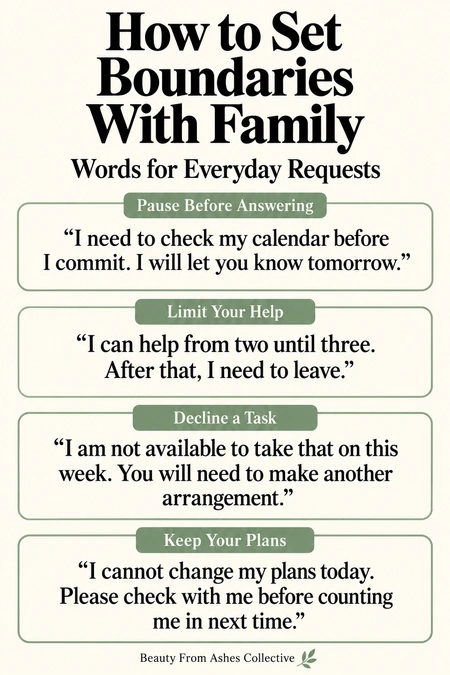
1. When you need time before answering a request
“I need to check my calendar before I commit. I will let you know tomorrow.”
Use this when a quick yes would create a problem later. Check your actual responsibilities, then give the answer you promised instead of leaving the person waiting indefinitely.
2. When you can help for a limited time
“I can help from two until three. After that, I need to leave.”
Use this when you want to contribute without giving the whole afternoon. Decide your departure time before arriving, and make arrangements that allow you to leave when you said you would.
3. When you cannot take on another task
“I am not available to take that on this week. You will need to make another arrangement.”
Use this when your capacity is already committed. Let the answer stand without volunteering yourself for a different task you also cannot manage. A clear answer gives the other person time to plan.
4. When help needs to be shared
“I can handle the appointment on Tuesday. I cannot manage every appointment. Let’s work out who can cover the others.”
Use this when a family responsibility has quietly become yours alone. Name your contribution and start a practical discussion about the remaining work instead of promising to do everything again.
5. When plans are made at the last minute
“I cannot change my plans today. Please check with me before counting me in next time.”
Use this when you have been included without being asked. Keep the plans you already made. You can consider a future invitation without treating today’s request as an obligation you agreed to.
What can you say when a conversation needs a clearer limit?
Name the conversation you are willing to have and the condition under which you will pause, finish, or return to it.
6. When voices become raised
“I want to talk about this. If the shouting continues, I will pause the conversation and come back to it later.”
Use this when a discussion becomes too heated to continue usefully. Follow through on the pause, and suggest a time to return if the conversation still needs to happen.
7. When nonurgent messages arrive late
“I put my phone away at nine. I will answer nonurgent messages in the morning.”
Use this when evening messages regularly take over your rest. Silence routine notifications. If you have caregiving responsibilities, agree on how urgent needs will reach you before changing your availability.
8. When a call runs longer than you can manage
“I have ten minutes to talk. When that time is up, I will need to go.”
Use this at the beginning of a call, rather than hoping the other person notices you are busy. At the end, say goodbye kindly and finish the call as planned.
9. When advice becomes repeated criticism
“I have heard your concern. I am not discussing my decision again today. I will change the subject now.”
Use this after you have listened and made a decision that belongs to you. You can acknowledge concern without spending the rest of the conversation defending the same choice.
10. When the same request keeps coming back
“I understand that you hoped for a different answer. My answer is still no.”
Use this when you have already given a clear response. Repeat it without supplying a fresh explanation each time. If the discussion keeps circling, end it and return to what you need to do.
How can you protect privacy, space, and money with clear words?
State what you will share, allow, or contribute, and keep your response specific to that request.
11. When someone asks for personal details
“I am keeping those details private. I can tell you how I am doing, but I am not sharing the whole story.”
Use this when curiosity reaches beyond what you want to disclose. Choose what you are comfortable sharing before the conversation. You can accept care without giving access to every detail.
12. When someone wants another family member’s information
“That is their story to share. I will not give out their private information.”
Use this when you are being asked to explain someone else’s life. Keep their confidence rather than filling the silence. If appropriate, suggest asking them directly and accepting that they may also choose privacy.
13. When you do not want physical affection
“I am not comfortable with a hug today. I am happy to say hello and sit with you.”
Use this when you want connection without that kind of touch. Offer another greeting only if you want to. Step back if needed rather than accepting contact you have already declined.
14. When someone asks to borrow money
“I am not able to lend money. I need to keep these funds for my own responsibilities.”
Use this when lending would interfere with obligations you already have. You do not need to disclose your account balance. Offer another kind of help only if it is realistic and freely chosen.
15. When belongings are used without permission
“Please ask before borrowing my things. I will keep this item put away when I am not using it.”
Use this when a request alone has not been enough. Connect the request to an action you control, such as storing the item securely, instead of repeatedly hoping the pattern will change.
What can boundaries sound like when family arrangements change?
They can state the arrangement you can keep now, without committing you to every future change or request.
16. When someone arrives without checking first
“Today is not a good time for a visit. Please arrange a time with me before coming over.”
Use this when unexpected visits disrupt your home or responsibilities. You can decline to host today and offer a different time if you want to. An unexpected arrival does not create your availability.
17. When a holiday plan is more than you can manage
“We can join you for lunch. We will head home afterward rather than stay for the whole day.”
Use this when you want to participate within your capacity. Tell the host ahead of time so expectations are clear, and arrange your own transportation if that helps you keep the plan.
18. When scheduling messages become personal arguments
“I will respond to the scheduling question. I will not continue the personal argument in this message thread.”
Use this when a practical exchange is being pulled into an unrelated conflict. Answer the information that needs an answer, then stop debating the personal comments. Keep your own reply focused on the arrangement.
19. When your home is expected to host everyone
“I can host four people this time. I cannot accommodate a larger gathering in my home.”
Use this when invitations grow beyond what you agreed to manage. State the number before plans are finalized. If more people need to attend, discuss another location rather than silently absorbing the extra work.
20. When you agreed before checking your capacity
“I answered too quickly. I need to change my answer: I cannot do that on Saturday.”
Use this as soon as you recognize the problem. Acknowledge the inconvenience and communicate promptly. Changing an answer is easier to work with than waiting until the last moment and hoping it resolves itself.
How can you honor boundaries when there is family distance?
Honor family distance by respecting the contact that is welcome, keeping private matters private, and deciding how you will respond when contact happens.
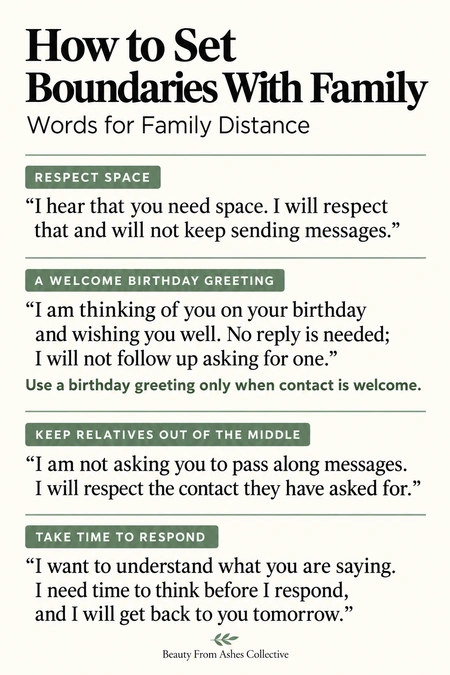
21. When an adult child asks for space
“I hear that you need space. I will respect that and will not keep sending messages.”
Use this when your adult child has clearly asked for less contact. Let your actions match your words. Do not send another message simply to check whether the first one was received.
22. When a birthday greeting is welcome
“I am thinking of you on your birthday and wishing you well. No reply is needed; I will not follow up asking for one.”
Use this only when a greeting fits the contact welcomed. Keep it free of questions or requests for reassurance. Honor a request for no contact instead of sending it.
23. When relatives are asked to carry messages
“I am not asking you to pass along messages. I will respect the contact they have asked for.”
Use this when family members are being pulled into the distance between you and someone else. Keep them out of the messenger role rather than using another person to get around a contact limit.
24. When others ask you to discuss the estrangement
“I am not sharing the details of that relationship. I am asking you to respect our privacy.”
Use this when questions at a gathering become more than you want to answer. Change the subject or step away if the questioning continues. Seek your own support in an appropriate, private setting.
25. When you need time to consider a painful conversation
“I want to understand what you are saying. I need time to think before I respond, and I will get back to you tomorrow.”
Use this when an immediate reply would be defensive or rushed. Choose a realistic time and keep it. A pause should leave room for a thoughtful response.
How do you practice a boundary with kindness and follow-through?
Choose one script, say it aloud in your own words, and decide what action you will take after the conversation.
If you need help preparing, use a boundaries worksheet.
Ask whether the limit fits your responsibilities and whether you can keep it. If your words came out sharply, repair the tone and state the limit again. You can bring the fear of disappointing someone to Christ without making their approval the condition for speaking honestly.
Lord Jesus, help me speak truthfully and listen well. Give me wisdom to choose a fair limit and the courage to keep it with kindness. Help me release the response I cannot control. Amen.
For support choosing your next faithful step as you rebuild, begin with the First Step Guide. Start with the situation that brought you here and one sentence you can practice today.
How can I set boundaries with family without sounding rude?
Use a calm, specific sentence about your availability or decision, and leave out accusations. “I cannot host this weekend” is clearer than explaining everything the family has done wrong. You can be considerate without changing an honest answer.
Should I apologize when I say no?
Apologize when you have caused an inconvenience or need to repair how you spoke. You do not have to apologize for every reasonable limit. “I know this changes your plans” can acknowledge the impact without withdrawing your answer.
What if someone says my boundary is selfish?
Consider whether the limit is fair and whether you are meeting your responsibilities. If it is reasonable, restate it briefly. Someone’s disappointment deserves consideration, but it does not automatically mean your decision needs to change.
Can I send a birthday message to an estranged adult child?
Send one only if it respects the contact they have welcomed. If they have asked for no contact, honor that request. A special date does not change the limit they communicated. You can hold your love and grief privately that day.
What if I feel guilty after setting a boundary?
Review what you said and did before deciding whether you need to change it. Did you neglect a responsibility, speak unkindly, or make an unfair demand? Repair what needs repair. If the limit was fair, give yourself time to practice it.
One faithful step at a time,
Elizabeth Jane