
Boundaries That Come From Love, Not Anger
Boundaries are the limits you set on your own behavior, not rules you impose on someone else's. A boundary says what you will do, not what they must stop doing — and that difference is why some boundaries hold and others turn into another argument.
Most of us learn this the hard way, after something has already broken. If that is where you are, you are not late.
This is the version that does not require you to be angry first.
What are boundaries, and why the angry ones do not hold
A boundary is not an ultimatum. It is not a punishment, and it is not a way of teaching someone a lesson.
It is a line you keep on your own side.
"You need to stop calling me at midnight" is a request. He may honor it. He may not. Either way you have handed him the decision.
"I turn my phone off at ten" is a boundary. It holds whether he cooperates or not, because the only person who has to act on it is you.
That is the difference, and it is usually why the ones set in anger do not hold. Anger reaches for the other person, because in that moment they are the problem. But you were never given the power to enforce a rule about someone else. You were only ever given your own next step.
Which one have you been trying to set?
Scripture puts it plainly, and it puts the responsibility in one place.
Galatians 6:5 — For every man shall bear his own burden.
If you want the fuller picture of the term itself, start with what are boundaries before you come back here.
What the bible says about boundaries
There is no verse that uses the word, but there are a great many that assume the boundaries.
Proverbs 4:23 — Keep thy heart with all diligence; for out of it are the issues of life.
Guard it. Not wall it. A guarded gate opens and closes; a wall only does one.
Matthew 5:37 — But let your communication be, Yea, yea; Nay, nay: for whatsoever is more than these cometh of evil.
Let your yes be yes. The rest — the explaining, the softening, the third paragraph justifying why you cannot come on Saturday — is not required of you.
Nehemiah 6:3 — And I sent messengers unto them, saying, I am doing a great work, so that I cannot come down: why should the work cease, whilst I leave it, and come down to you?
This is the clearest boundary in scripture and nobody quotes it. Nehemiah is asked, four separate times, to come down off the wall and meet with people who mean him harm. He does not argue and he does not explain. He says he is doing something and he is not stopping.
Mark 6:31 — And he said unto them, Come ye yourselves apart into a desert place, and rest a while: for there were many coming and going, and they had no leisure so much as to eat.
And Christ withdrew from people who needed him. Not once — repeatedly, and on purpose.
There is more on this in what the bible says about boundaries, including the verses people use badly.
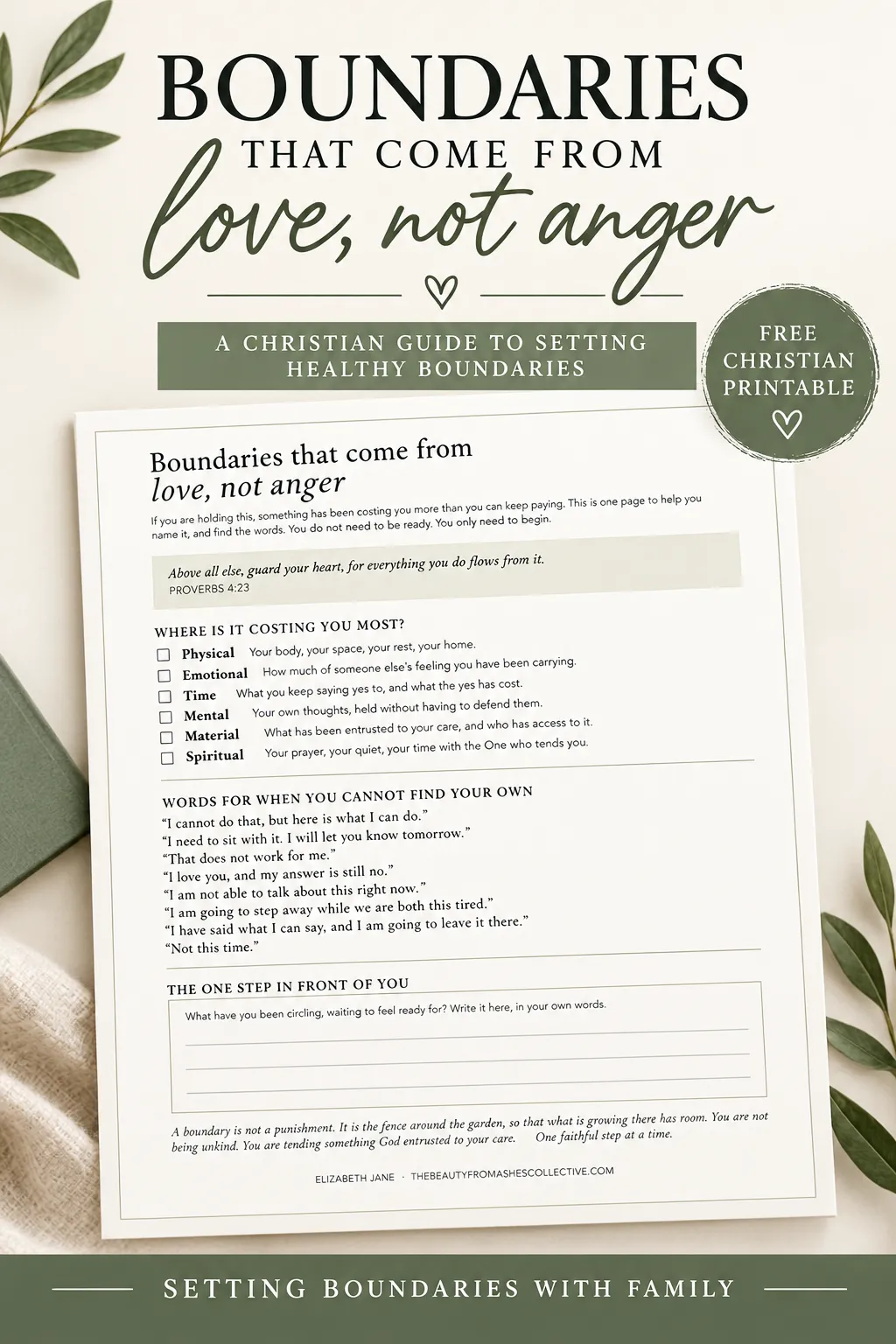
How to set boundaries that come from love, not anger
Six steps, and the order matters more than the wording. Most of us start at step three, which is why it comes out sounding like an accusation when we did not mean it to.
1. Name what it is costing you.
Not what they did. What it is costing you. "I am losing the whole evening to this." "I dread Sundays now." A boundary you cannot name a cost for is usually a preference, and preferences do not need defending.
2. Decide what you will do, not what they should.
Everything else rests here. Write it as a sentence beginning with I — and if you cannot, you have not found the boundary yet. That is worth knowing, not worth panicking about.
3. Say it once, plainly, without the reasons.
The explanation is where boundaries go to die. Every reason you offer is a door, and a determined person will walk through any of them. "That does not work for me" is a complete sentence.
There are more of them in what boundaries sound like if the words are the part you get stuck on.
4. Decide in advance what you do if it is ignored.
Not a threat. A plan, for you. "If he raises his voice, I end the call." You are not warning anyone. You are deciding now so you do not have to decide while upset.
5. Expect it to feel unkind, and do it anyway.
It will feel unkind for a while. That feeling is not evidence that you are wrong; it is evidence that you are doing something unfamiliar.
What would you do differently this week if you believed you were allowed to?
6. Keep it exactly.
One improvised exception tends to undo a month. Not because anyone is keeping score, but because you will be the one arguing with yourself about it next time.
The six types of boundaries, and which one is under strain
All six steps assume you already know which boundary you need. Most of us do not.
Most people set the same kind of boundary over and over, because it is the one they know how to set. The one that would actually help is usually a different one.
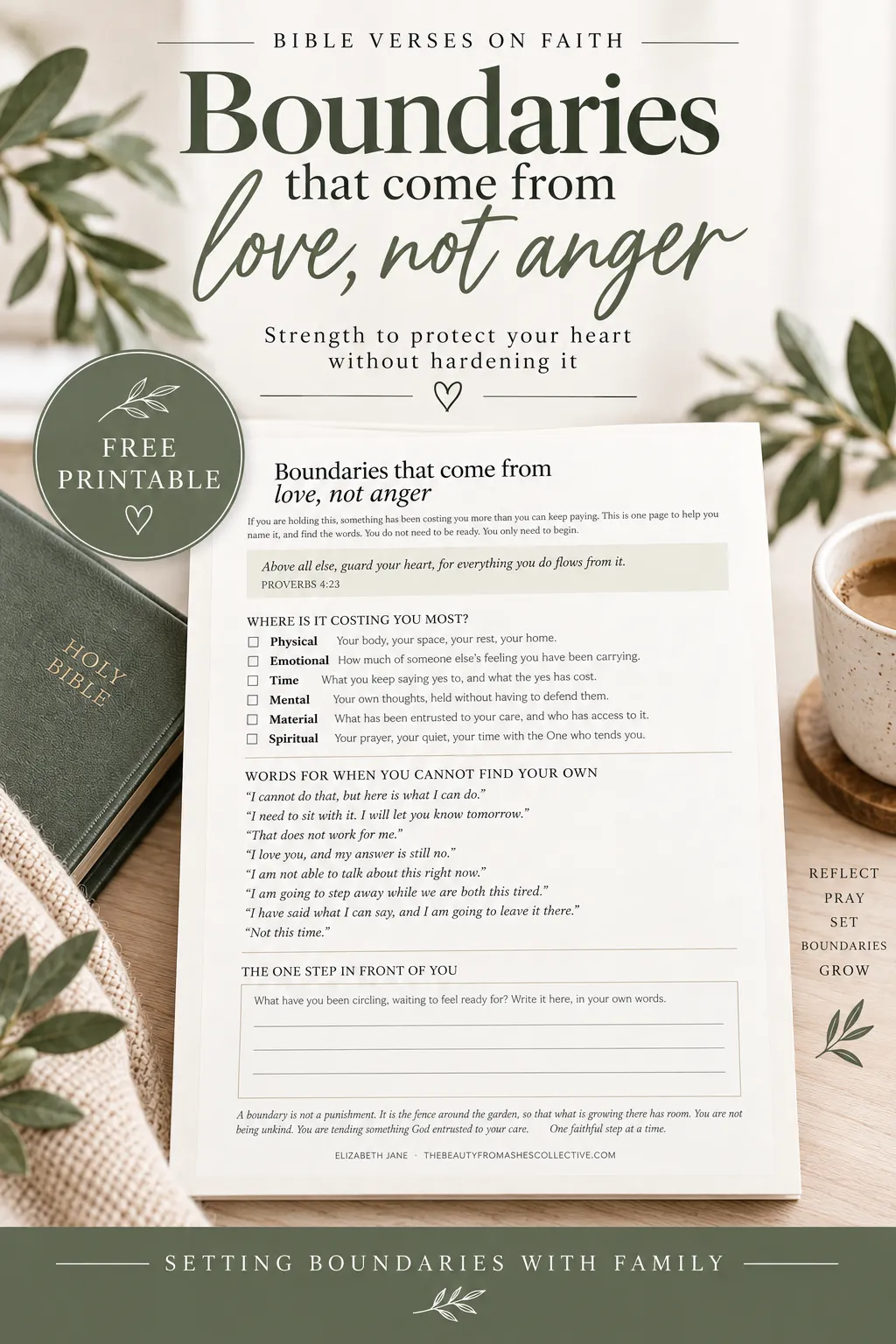
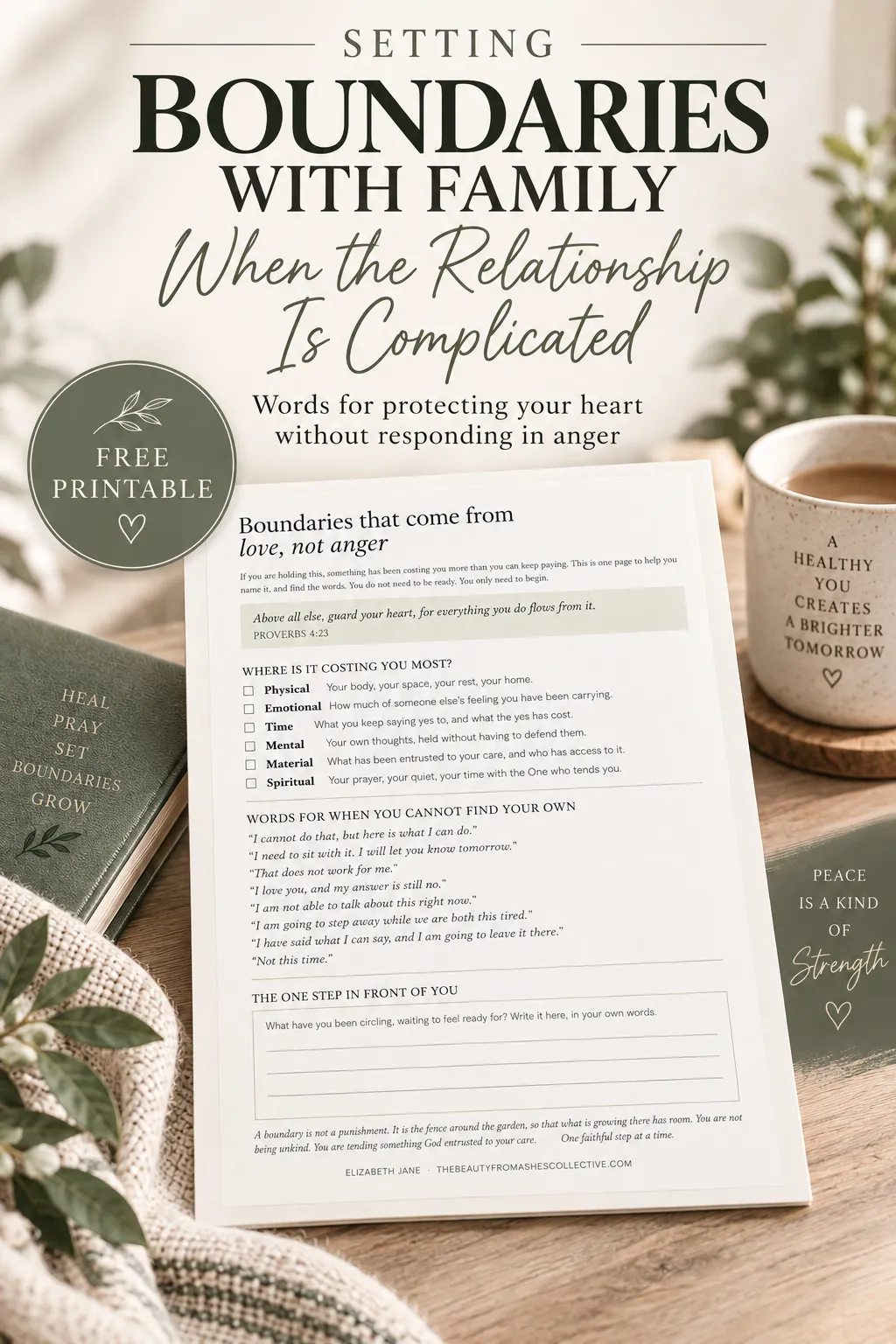
Physical — your body, your space, your rest, your home. Emotional — how much of someone else's feeling you carry. Time — what you keep saying yes to, and what the yes has cost. Mental — your own thoughts, held without having to defend them. Material — what has been entrusted to your care, and who has access to it. Spiritual — your prayer, your quiet, your time with the One who tends you.
Read them again slowly. Which one did you skim past?
That is usually the one.
The full version, with a question under each, is in types of boundaries.
Setting boundaries with family when the other person will not cooperate
Everything above assumes the other person is reasonable. Sometimes they are not, and no wording will change that.
That is not a failure of your boundary. It is information about what kind of boundary you need.
Scripture is realistic about this, and it puts a condition in the sentence.
Romans 12:18 — If it be possible, as much as lieth in you, live peaceably with all men.
If it be possible. As much as lieth in you. Both halves are conditions, and both are about your side of it. Nobody is asking you to produce peace on your own.
When cooperation is not available, the boundary stops being a conversation and becomes a practice. You put things in writing, not to build a case but to stop rehearsing conversations at two in the morning. You answer the question and not the tone. You keep the arrangement exactly, because every improvised kindness becomes next month's argument.
You are not trying to be understood. You are trying to get through the week.
Setting boundaries without guilt: the one you need this week
That is a lot to hold at once. Here is the only part that matters today.
Read back over the six types and pick the one that is hardest right now. Then write one sentence beginning with I.
Not a list. One.
Boundaries rarely fail because the woman setting them lacks resolve. They fail because she tried to fix six things at once, in a week when she was already tired.
What is the one thing you have been circling, waiting to feel ready for?
If it helps to have it on paper, there is a boundaries worksheet with the six types and room to write.
Where to start when you do not know which one to set
If you have read all of that and still cannot tell which line needs drawing, that is worth knowing rather than guessing at.
Usually it means the boundary is not the first problem. Something else has run low — energy, or clarity, or the sense that you are allowed to want anything at all — and a limit set from empty tends not to hold.
I wrote a short guide for exactly that. Your First Step Guide takes one area of your life and gives you the single next thing to do in it, rather than a list of everything you are behind on. It is $17, it is about twenty pages, and it is meant to be read in one sitting on a bad evening.
A boundary is not a punishment. It is the fence around the garden, so that what is growing there has room. You are not being unkind. You are tending something God entrusted to your care.
You do not have to become a completely different person to faithfully steward the life God has entrusted to you. You simply need to begin, right here, right now, with what is already in your hands.
One faithful step at a time,
Elizabeth Jane