
A Boundaries Worksheet You Can Actually Use
What would change this week if you could put one needed boundary into words before the next difficult conversation?
A boundaries worksheet can help you name what keeps happening, decide what you need, and prepare a response you can follow through on. You do not have to untangle every relationship before you begin. Choose one situation and give yourself enough room to tell the truth about it.
Maybe you keep saying yes before checking your calendar. Maybe a family conversation always leaves you defending a decision you already made. Maybe your phone keeps pulling you away from the quiet you need. Start there, with an ordinary moment that needs a clearer limit.
What is a boundaries worksheet supposed to help you do?
A boundaries worksheet helps you turn a repeating problem into a specific limit, a clear sentence, and an action you can take.
Writing it down gives you somewhere to begin when your thoughts feel tangled. It also helps you notice whether your plan depends on your choices or on someone else finally agreeing with you. You can ask another person to change. Your boundary still needs an action that belongs to you.
For example, you might ask someone to call earlier. Your own limit could be that you stop answering nonurgent calls after a certain hour.
How do you choose the first boundary to work on?
Choose one recurring situation that is costing you time, rest, privacy, or the ability to speak honestly.
Describe what happens without trying to explain the other person's motives. “I agree to last-minute plans and cancel my rest” gives you more to work with than “Nobody respects me.” You are looking for the part of the pattern you can address.
If you need help naming the area involved, read about the types of boundaries.
Then ask yourself what you want to protect. It might be an evening at home, time to consider a request, or the freedom to keep a personal decision private. Pick one need you can describe plainly.
How do you turn that need into a clear boundary?
Turn your need into a boundary by naming your limit and deciding what you will do to keep it.
Try this sentence: “I am available for ______. I am not available for ______. If ______ happens, I will ______.” You may only need part of that sentence in the conversation. The full version helps you prepare.
For a request, you could say, “I need to check my calendar before I commit. I will let you know tomorrow.” Your follow-through is to check before answering, even if you feel pressure to give an immediate yes.
For a conversation, you could say, “I am willing to talk about this. If we start calling each other names, I will pause the conversation and return to it later.” Choose a step you can carry out, rather than a consequence designed to punish.
Leave out the long defense of why you deserve the limit. A brief explanation can be kind. You do not need to answer every possible objection before you have even spoken.
What should you write in your boundaries worksheet?
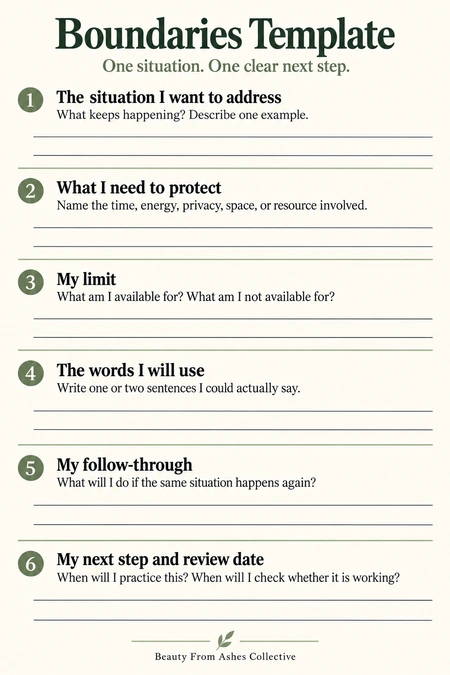
Write the situation, your need, your limit, the words you will use, and the action you will take afterward.
Copy these prompts into a notebook or a blank document. Leave a few lines beneath each one. Short, honest answers are enough; you are preparing for one real moment.
1. The situation I want to address: ______
What keeps happening? Describe one example.
2. What I need to protect: ______
Name the time, energy, privacy, space, or resource involved.
3. My limit: ______
What am I available for? What am I not available for?
4. The words I will use: ______
Write one or two sentences I could actually say.
5. My follow-through: ______
What will I do if the same situation happens again?
6. My next step and review date: ______
When will I practice this? When will I check whether it is working?
What does a completed boundaries worksheet look like?
A completed worksheet connects one everyday problem to a realistic limit and a simple response.
Here is an example you can adapt. This is an illustration, so change the details to fit your responsibilities.
Situation: I answer nonurgent family messages late at night and stay awake much longer than I planned.
Need: An uninterrupted hour to wind down before bed.
Limit: I will check nonurgent messages the next morning after 8 a.m.
Words: “I am putting my phone away at 9 p.m. If you send a nonurgent message after that, I will reply in the morning.”
Follow-through: I will silence routine notifications and leave my phone outside the bedroom.
Next step: I will start tonight and review the plan on Sunday.
Notice how specific that is. It tells the other person what to expect and gives you a practical way to keep the limit. If you have caregiving or emergency responsibilities, build the appropriate contact arrangement into your plan. A useful boundary makes room for your actual life.
How can Bible verses on faith help you reflect on a boundary?
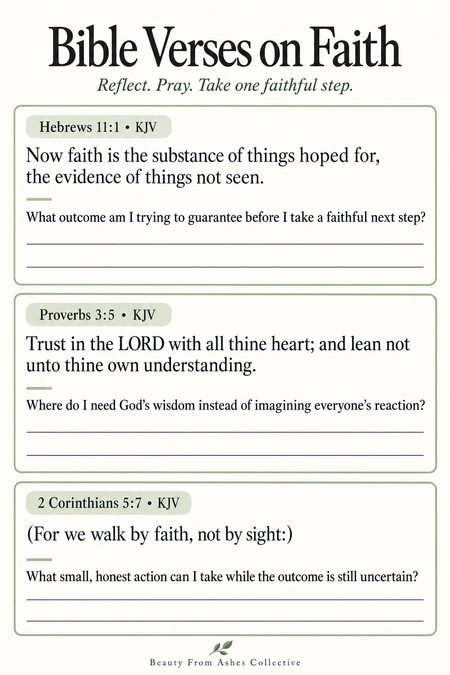
Bible verses on faith can help you bring uncertainty to God while you prepare a thoughtful, honest response.
These passages speak about trust and faith. They are not instructions for this particular worksheet. Use them as a place for prayer and reflection, without treating a verse as proof that every limit you choose must be right.
Hebrews 11:1, KJV: “Now faith is the substance of things hoped for, the evidence of things not seen.”
Reflection: What outcome am I trying to guarantee before I take a faithful next step?
My answer: ______
Proverbs 3:5, KJV: “Trust in the LORD with all thine heart; and lean not unto thine own understanding.”
Reflection: Where do I need God's wisdom instead of another round of imagining everyone's reaction?
My answer: ______
2 Corinthians 5:7, KJV: “For we walk by faith, not by sight:”
Reflection: What small, honest action can I take while the outcome is still uncertain?
My answer: ______
You can care about someone's feelings and still speak truthfully about your capacity. If you need to examine your intention, spend time with boundaries that come from love.
Lord Jesus, help me see what is mine to do. Give me wisdom to choose a fair limit, courage to speak with kindness, and patience to follow through. Help me trust You with the response I cannot control. Amen.
How do you follow through when keeping the boundary feels uncomfortable?
Follow through by returning to the sentence and action you prepared, then reviewing what happened without shaming yourself.
Read your words aloud before the conversation. If they sound unlike you, simplify them. “I cannot do that this week” may be more natural than a carefully polished speech.
If someone asks again, you can repeat the same answer: “I understand you were hoping I could help. I am still not available this week.” You do not need a new explanation each time.
Afterward, record what you said, what you did, and what needs adjusting. If you agreed too quickly, you can correct it: “I answered before checking. I need to change my answer.” If your plan overlooked a responsibility, revise it. Learning to keep a boundary includes learning to make it clear, fair, and workable.
What is one next step you can take today?
Complete the worksheet for one situation today, then practice your boundary sentence before you need it.
Keep the page somewhere you can return to it. You can add another situation later. For now, one honest sentence and one action are enough to practice.
If you would like support choosing your next step, begin with the First Step Guide. Bring the situation you named here with you as you consider where to begin.
Can I use this boundaries worksheet with family?
Yes. Choose one family situation and write a limit that fits your responsibilities and capacity. Keep the wording specific, respectful, and connected to an action you can take. You do not have to address every family pattern in one conversation.
What if I do not know what boundary I need?
Start with what happens and what you need afterward. If a request leaves you scrambling, you may need time before answering. If a conversation repeatedly becomes insulting, you may need a plan to pause it. Naming the situation usually gives you a clearer starting point.
Is a boundary the same as telling someone what to do?
No. A boundary states your limit and your response. A request asks for another person's cooperation. You can make both, but your worksheet should include a step you can take even if the other person declines your request.
What if I feel guilty after setting a boundary?
Review whether you were honest, kind, and fair, and whether you met your actual responsibilities. Guilt can be a reason to examine your choice; it does not settle the question by itself. Pray, seek wise perspective when needed, and correct anything that needs correcting.
How often should I review the worksheet?
Review it after you try the boundary and whenever the situation changes. Ask whether your words were clear and your action was realistic. Keep what worked, adjust what did not, and set a date to practice again.
One faithful step at a time,
Elizabeth Jane