
6 Types of Boundaries and How to Tell Which One You Need
Which types of boundaries do you need when you love your family but feel stretched, unheard, or unsure what you are allowed to ask for? Six common areas are physical, emotional, intellectual, time, material, and sexual boundaries. Naming the area can help you see what needs protection and choose a clear, practical response.
You do not have to change every relationship today. You can begin with the situation that keeps asking for more than you can freely give, then take one faithful step toward a limit you can honor.
What are the six types of boundaries?
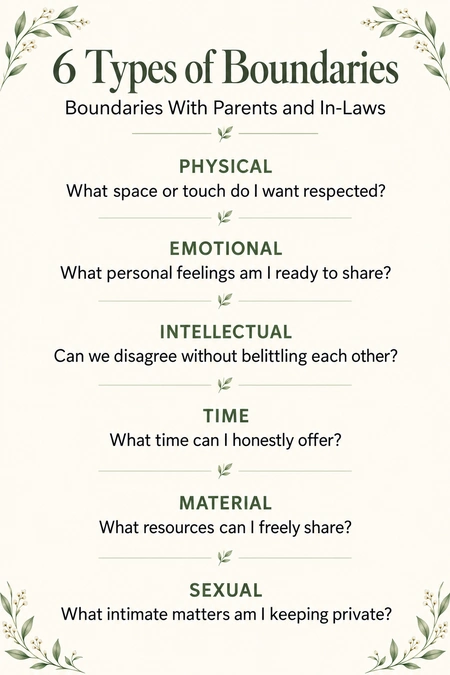
The six types of boundaries covered here protect your body and space, emotional sharing, thoughts and beliefs, time, possessions, and intimate choices. These categories overlap; they are a useful way to sort a situation rather than a test you have to get right.
Therapist Nedra Glover Tawwab describes these six areas in her boundaries work. The examples and reflection questions below apply those areas to everyday rebuilding, family relationships, and stewardship.
For years, I managed the home, yard, schedules, and shopping while teaching Pilates and caring for my family. I knew how to notice what everyone needed. I also knew the exhaustion of carrying so much. Rebuilding after divorce has asked me to notice my own capacity, too. A needed boundary sometimes begins with a very ordinary question: Do I actually have room for this?
1. What do physical boundaries protect?
Physical boundaries protect your body, personal space, privacy, and preferences around touch. You may need one when someone enters your space or touches you in a way you have not welcomed. With family, you might say, “Please call before coming over.” Ask yourself: What would help me feel comfortable in my own space?
2. What do emotional boundaries protect?
Emotional boundaries guide what you share, whom you trust with it, and how you respond to another person’s feelings. You may need one when a conversation repeatedly leaves you carrying more than you can manage. Try: “I can listen for a little while today.” Ask yourself: What am I ready and able to share or receive?
3. What do intellectual boundaries protect?
Intellectual boundaries protect respectful treatment of your thoughts, beliefs, and opinions. You may need one when disagreement becomes belittling or someone pressures you to debate a personal conviction. Try: “We see this differently, and I am going to leave this conversation here.” Ask yourself: Can I express my view without being mocked or pushed?
4. What do time boundaries protect?
Time boundaries protect the hours you need for responsibilities, rest, relationships, and work. You may need one when requests routinely crowd out commitments you already made. Try: “I can visit Saturday for an hour, and then I need to leave.” Ask yourself: What can I agree to and still honor what is already on my calendar?
5. What do material boundaries protect?
Material boundaries guide how your possessions and resources are used, shared, or borrowed. You may need one when lending money or belongings would leave you without what you need. Try: “I am not able to lend that right now.” Ask yourself: What can I freely offer while caring for the resources entrusted to me?
6. What do sexual boundaries protect?
Sexual boundaries protect consent, intimate privacy, and your choices about sexual touch or conversation. You may need one when intimate questions, comments, or contact are unwanted. Try: “I am keeping that part of my life private.” Ask yourself: Is this freely chosen, and does it respect my body and values? Your consent matters.
How do you tell which boundary you need first?
Start with the recurring situation, identify what is being affected, and choose one limit you can act on. The category helps you name the need; the behavior tells you where to begin.
A parent arriving without warning may call for a physical boundary around access to your home and a time boundary around availability. An in-law pressing you for personal details may involve emotional or sexual privacy. You can name the specific behavior without making a judgment about the whole person.
Write three short sentences: “What keeps happening is ______. What I need to protect is ______. The action I can take is ______.” If the issue is an unplanned visit during work, your action might be to keep working and arrange a visit for another time. Choose something you can carry out with integrity.
How can you set boundaries with parents or in-laws?
Set boundaries with parents or in-laws by naming the specific limit, communicating it respectfully, and explaining what you will do. A clear boundary lets people know what to expect from you.
You might say, “We would love to arrange a visit. Please check with us before coming over.” Or, “I appreciate your concern. I am keeping those details private.” You can acknowledge affection and care while being honest about the limits of your availability or sharing.
Give a brief explanation when it helps, then allow your answer to stand. If you need to discuss a shared home or schedule with your spouse, agree on what you can each honor before making a promise. Speak for your own actions and avoid volunteering another adult for a commitment they have not accepted.
For more ways to put a limit into words, read what boundaries sound like.
How can faith help you practice these boundaries?
Faith can help you ask for wisdom, examine your motives, and practice a limit with both honesty and compassion. Bring the specific situation to God instead of waiting until you have every answer.
James 1:5 begins, “If any of you lack wisdom, let him ask of God” (KJV excerpt). I find comfort in that invitation. I can ask for help seeing what is mine to steward, where I need to speak clearly, and where I need to listen.
Your body, time, relationships, and resources deserve thoughtful care. A boundary can help you offer a willing yes and an honest no. If you want to explore the heart behind these choices, read about boundaries that come from love.
Use these six questions for reflection: How can I care for my body and space? What emotional sharing can I offer today? How can I express my convictions with respect? Which commitments can I faithfully honor? What resources are mine to steward? How can I honor consent and intimate privacy?

Father, give me wisdom for the situation in front of me. Help me speak with clarity, honor my responsibilities, and care for the people I love without taking ownership of choices that belong to them. Show me one faithful step I can take today. Amen.
What is one small boundary you can practice today?
Choose one situation, write one clear sentence, and decide on one action you can follow through on. A small, dependable limit gives you somewhere real to begin.
You might check your calendar before saying yes, keep a private matter private, or ask for a visit to be arranged in advance. Give yourself room to learn. You can notice what worked and make your words clearer next time.
If you would like support finding your starting point in a rebuilding season, the First Step Guide can help you take the next faithful step.
God gives the growth. We give the stewardship.
Frequently asked questions
Do I need all six types of boundaries?
The six areas can help you notice different needs, but you do not need to set six new limits at once. Begin with one situation that needs attention. Some boundaries may already be clear and respected in your life.
Can one situation involve more than one type?
Yes. An unexpected visit can affect both your personal space and your time. Pressure to discuss an intimate matter may affect emotional and sexual privacy. Choose the action that addresses the actual situation rather than worrying about which label is perfect.
Can I set a boundary with someone I love?
Yes. You can love someone and communicate honestly about what you can offer, discuss, or participate in. Use clear language, respect their freedom to respond, and follow through on the actions that are yours to take.
What if someone says my boundary is unkind?
Listen to the concern and examine your wording, responsibilities, and follow-through. You can repair a harsh delivery or clarify a confusing limit while keeping a reasonable boundary. Disappointment alone does not decide whether your limit is appropriate.
What if a limit is repeatedly ignored?
Follow through on the action you named and reconsider how much access or participation you can responsibly offer. If communicating a limit could put you in danger, prioritize safety and seek trusted support. Another explanation is not always the next useful step.
One faithful step at a time,
Elizabeth Jane