
What Are Boundaries, Really
What are boundaries when you love the people in your life, want to honor God, and are tired of saying yes when you have nothing left to give? Boundaries are clear limits that help you take responsibility for your own time, body, choices, and participation in a relationship. They give you a way to be honest about what you can offer and what you will do when a limit is crossed.
You can care deeply and still need rest. You can listen with compassion and still end a hurtful conversation. Learning to name those limits is one small part of faithfully tending the life God has entrusted to you.
What are boundaries in everyday life?
Boundaries are limits you communicate and practice around what you will accept, share, give, or participate in. A boundary becomes useful when it guides an action you can actually take.
A time boundary might sound like, “I can help for an hour.” A physical boundary might be, “Please ask before hugging me.” A conversation boundary might be, “If the name-calling continues, I will end this call.” Each one makes your limit clear without requiring another person to become someone different first.
For years, I managed the home, the yard, the schedules, and the shopping while teaching Pilates and caring for my family. I was used to noticing what everyone needed and trying to take care of it. I also knew the exhaustion that came with carrying so much. Rebuilding after divorce has asked me to look honestly at what is mine to tend and where I have been trying to carry too much.
My time, energy, and voice matter in that stewardship. Yours do, too. A boundary gives that truth somewhere practical to land.
How is a boundary different from controlling someone?
A boundary names your limit and the action you will take; controlling behavior tries to take ownership of another person’s choices. The clearest test is whether you can carry out your boundary yourself.
“You must answer every message immediately” puts a demand on someone else. “I will check messages after work and respond when I am available” describes your own practice. You can ask for something you need, but a request becomes a boundary when you know how you will respond if the answer is no.
For example: “Please lower your voice. If the yelling continues, I will leave the conversation and we can try again later.” The request is for a calmer voice. The boundary is your decision about participating. Choose a follow-through that is proportionate, possible, and intended to protect the limit you named.
How do you know which boundary you need?
Identify the specific situation that repeatedly costs you more than you can freely give, then name what needs protection. Look at the behavior and your capacity before deciding on the limit.
You might notice that you keep agreeing to plans when you need sleep, lending things you need yourself, or listening to criticism long after the conversation has stopped being constructive. Resentment or exhaustion can invite you to look more closely, but they do not tell the whole story. Ask what happened, what you agreed to, and what you can responsibly change.
Different situations call for different types of boundaries.
Begin with one sentence: “I need to protect ______ so I can ______.” That might be your rest so you can show up for your children, your work time so you can meet a commitment, or your privacy so you can decide what you are ready to share.
How can you set boundaries with yourself?
Set boundaries with yourself by choosing a small, specific limit on your own habits and deciding how you will support it. These limits help your daily choices reflect what you value.
You might decide to check your calendar before accepting another commitment, stop rereading a difficult message at bedtime, or pause before offering to solve a problem no one has asked you to solve. The purpose is to make room for a steadier choice. You do not have to shame yourself into following through.
Try this short reflection on paper. Write the situation as plainly as you can, then finish each prompt:
The situation I keep returning to is: ______.
What I am responsible for is: ______.
What I cannot decide for someone else is: ______.
The limit I need is: ______.
The action I can take is: ______.
One faithful step I will practice this week is: ______.
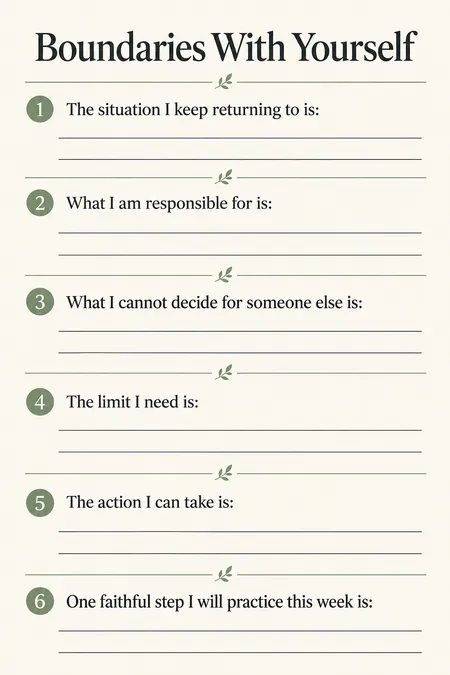
For example, the situation might be accepting extra plans before checking whether you have time. Your limit could be, “I will look at my calendar before I commit.” Your next step is to say, “Let me check and get back to you tomorrow.” A small pause can help you give an answer you can honor.
How do you communicate a boundary clearly?
Communicate a boundary by naming the situation, stating your limit, and describing your next action in a few calm sentences. Use words that leave the other person able to understand what you mean.
You could say, “I want to talk about this. I am available tomorrow afternoon, and I will return your call then.” Or, “I can listen, but I am not available to be spoken to that way. I will end the call if the insults continue.” You can be warm and direct at the same time.
If you need a little time, take it. Write the sentence down, read it aloud, and remove explanations that distract from the actual limit. A brief reason can be helpful. You do not need a complete history of your life to explain why you cannot come over tonight.
For a deeper look at the heart behind these conversations, explore boundaries that come from love.
What do you do after you have stated a boundary?
Follow through with the action you named, observe what happens, and adjust the boundary if your circumstances or responsibilities change. Consistency helps make your words dependable.
If you said you would end a call when insults continued, end it when they continue. If you said you could stay for an hour, leave when that hour is over. You may need to repeat the limit. Repeating it does not require making a longer case for it.
Someone may feel disappointed, and you can acknowledge that: “I understand you hoped I could stay longer.” Their feelings deserve care, while your answer can remain clear. You can also hear respectful feedback and reconsider a limit that was unclear or unrealistic. Boundaries are a practice of responsibility, and responsibility includes being willing to learn.
How can faith support you when boundaries feel difficult?
Faith can support you by giving you a place to ask for wisdom, receive courage, and examine whether your choices reflect love and truth. You can bring an uncertain conversation to God before you have perfect words for it.
Luke 5:15–16 describes crowds coming to hear Jesus and seek healing, followed by His withdrawal to pray. I take encouragement from that rhythm: making room for prayer belongs alongside caring for people. That is an application of the passage, rather than a rule that settles every relationship question.
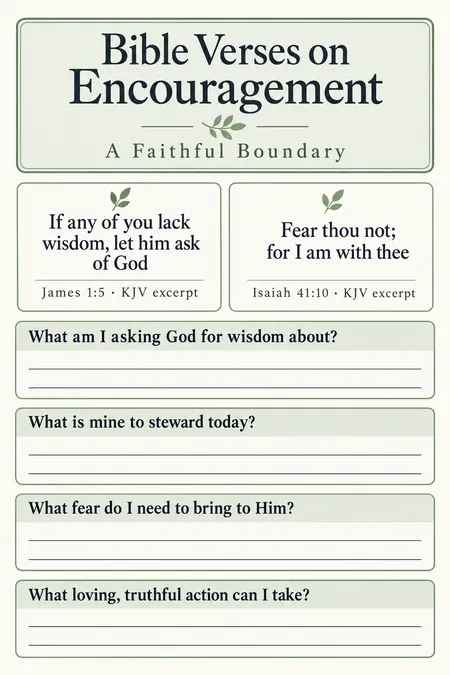
James 1:5 begins, “If any of you lack wisdom, let him ask of God” (KJV excerpt). Ask for help seeing your responsibility clearly. Isaiah 41:10 begins, “Fear thou not; for I am with thee” (KJV excerpt). God’s words to Israel offer encouragement to bring your fear to Him as you take the next faithful step.
Use these prompts when a boundary feels hard: What am I asking God for wisdom about? What is mine to steward today? What fear do I need to bring to Him? What loving, truthful action can I take?
Father, help me see what You have entrusted to me. Give me wisdom to speak clearly, tenderness toward the people I love, and courage to follow through with integrity. Help me release the choices I cannot make for someone else. Amen.
What is one boundary you can practice today?
Choose one manageable limit and one action you can take today, such as checking your calendar before agreeing to a request. Starting small gives you a real place to practice.
You can write the sentence now. You can pause before answering. You can honor the stopping time you chose. You do not need to solve every relationship to begin caring faithfully for what is in your hands.
If you would like support choosing a starting point in your rebuilding season, the First Step Guide can help you take the next faithful step.
God gives the growth. We give the stewardship.
Frequently asked questions
Are boundaries selfish?
Healthy boundaries can support responsible care for yourself and others. Consider whether your limit protects a real need, respects the other person’s freedom, and allows you to honor your responsibilities. Those questions help you distinguish stewardship from simply avoiding inconvenience.
Do boundaries have to be spoken out loud?
Boundaries that affect another person usually need clear communication so they know what to expect. Limits on your own habits, such as checking your calendar before committing, can be practiced privately. Avoid expecting someone to follow a limit you have never explained.
Why do I feel guilty when I set a boundary?
Guilt may arise because the limit is unfamiliar, someone is disappointed, or you believe you have failed a responsibility. Look at the actual facts: have you broken a commitment, or have you given an honest answer? You can repair a mistake while continuing to practice a needed limit.
Can I change a boundary later?
Yes, you can change a boundary when your capacity, circumstances, or understanding changes. Explain the new limit clearly, especially if someone has been relying on the old arrangement. Reconsidering thoughtfully can be part of responsible follow-through.
What if someone keeps ignoring my boundary?
Carry out the action you can control and consider what access or participation you are willing to continue. Repeated disregard may call for more distance or support from a trusted person. If stating a limit could put you in danger, prioritize safety and seek help rather than relying on another explanation.
One faithful step at a time,
Elizabeth Jane